EARTH: Excavation Autonomy with Resilient Traversability and Handling


Center for Embodied Autonomy and Robotics (CEAR)
University at Buffalo

Simulation Environment (TERA)

Developing excavation autonomy is challenging given the environments where excavators operate, the complexity of physical interaction and the degrees of freedom of operation of the excavator itself. Simulation is a useful tool to build parts of the autonomy without the complexity of experimentation. Traditional excavator simulators are geared towards high fidelity interactions between the joints or between the terrain but do not incorporate other challenges such as perception required for end-end autonomy. A complete simulator should be capable of supporting real-time operation while providing high fidelity simulation of the excavator(s), the environment, and their interaction. In this paper we present TERA (Terrain Excavation Robot Autonomy), a simulator geared towards autonomous excavator applications based on Unity3D/AGX that provides the extensibility and scalability required to study full autonomy. It provides the ability to configure the excavator and the environment per the user requirements. We also demonstrate realistic dynamics by incorporating a time-varying model that introduces variations in the system’s responses. The simulator is then evaluated with different scenarios such as track deformation, velocities on different terrains, similarity of the system with the real excavator and the overall path error to show the capabilities of the simulation.

Safe Control with CLF-CBF-QP

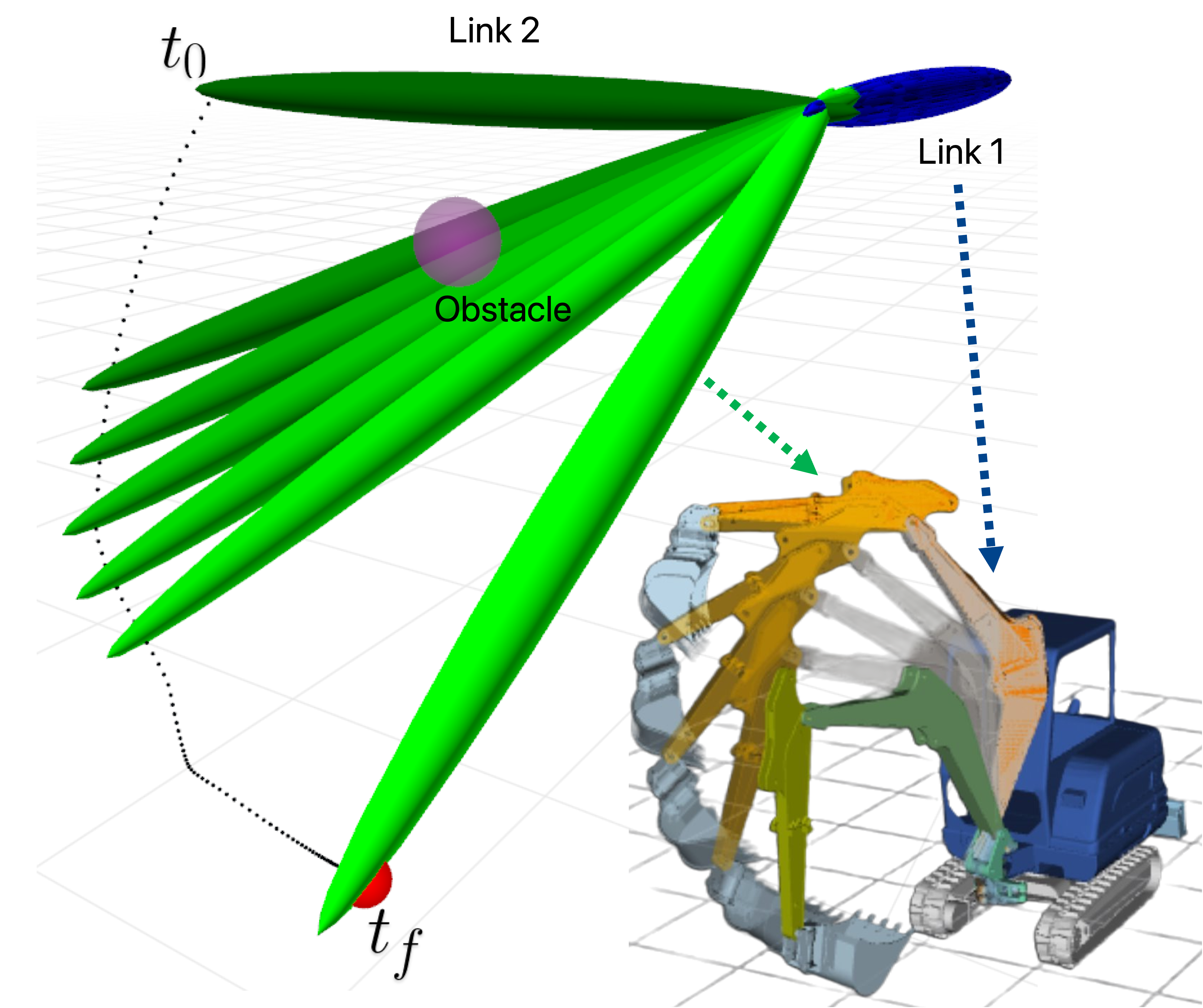
Safe planning not only mitigates risks associated with human injury, equipment damage, and environmental harm but also optimizes efficiency by enforcing constraints on key parameters. Consider the challenges excavators face: navigating through dense urban areas while avoiding collisions with buildings, digging around underground utilities without causing damage, operating in human collaborative workspace. By leveraging Control Lyapunov and Control Barrier functions (CLFs-CBFs) ], we can design reactive control-based planners that proactively respond to obstacles, ensuring safe operation well before any potential collisions occur. This approach provides formal guarantees of safety and stability, aligning with stringent industry standards.

Safe Planning

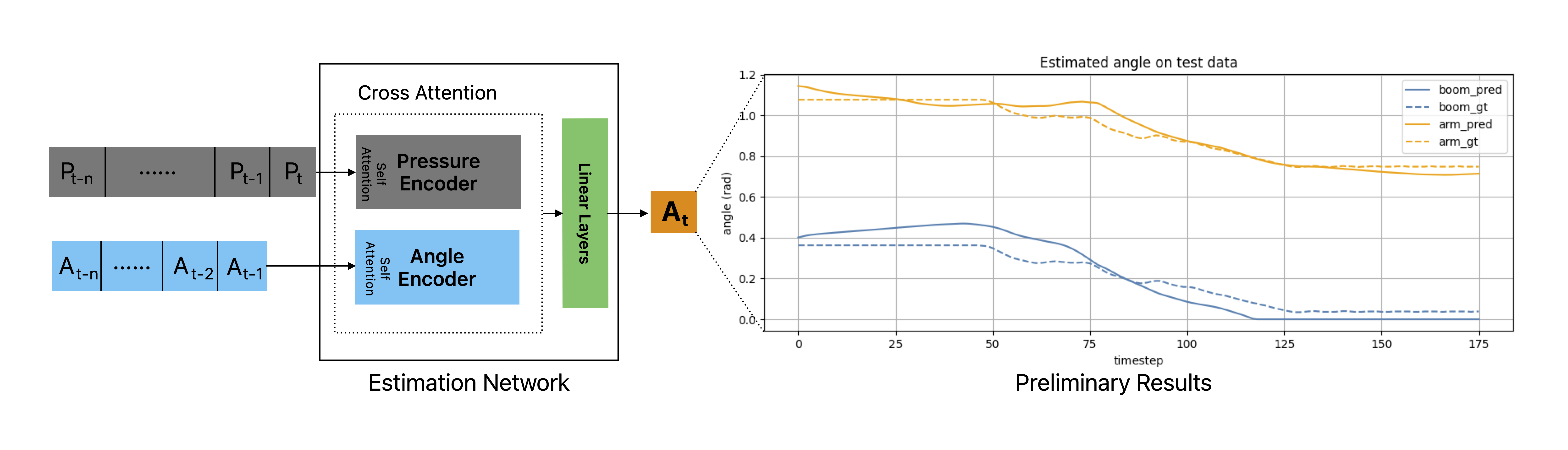
Arm State-Estimation with Fluid Pressure

Arm State-Estimation with Fluid Pressure

Developing excavation autonomy is challenging given the environments where excavators operate, the complexity of physical interaction and the degrees of freedom of operation of the excavator itself. Simulation is a useful tool to build parts of the autonomy without the complexity of experimentation. Traditional excavator simulators are geared towards high fidelity interactions between the joints or between the terrain but do not incorporate other challenges such as perception required for end-end autonomy. A complete simulator should be capable of supporting real-time operation while providing high fidelity simulation of the excavator(s), the environment, and their interaction.

Diffusion-based Trajectory Planning for Excavators with Learned Dynamics Models

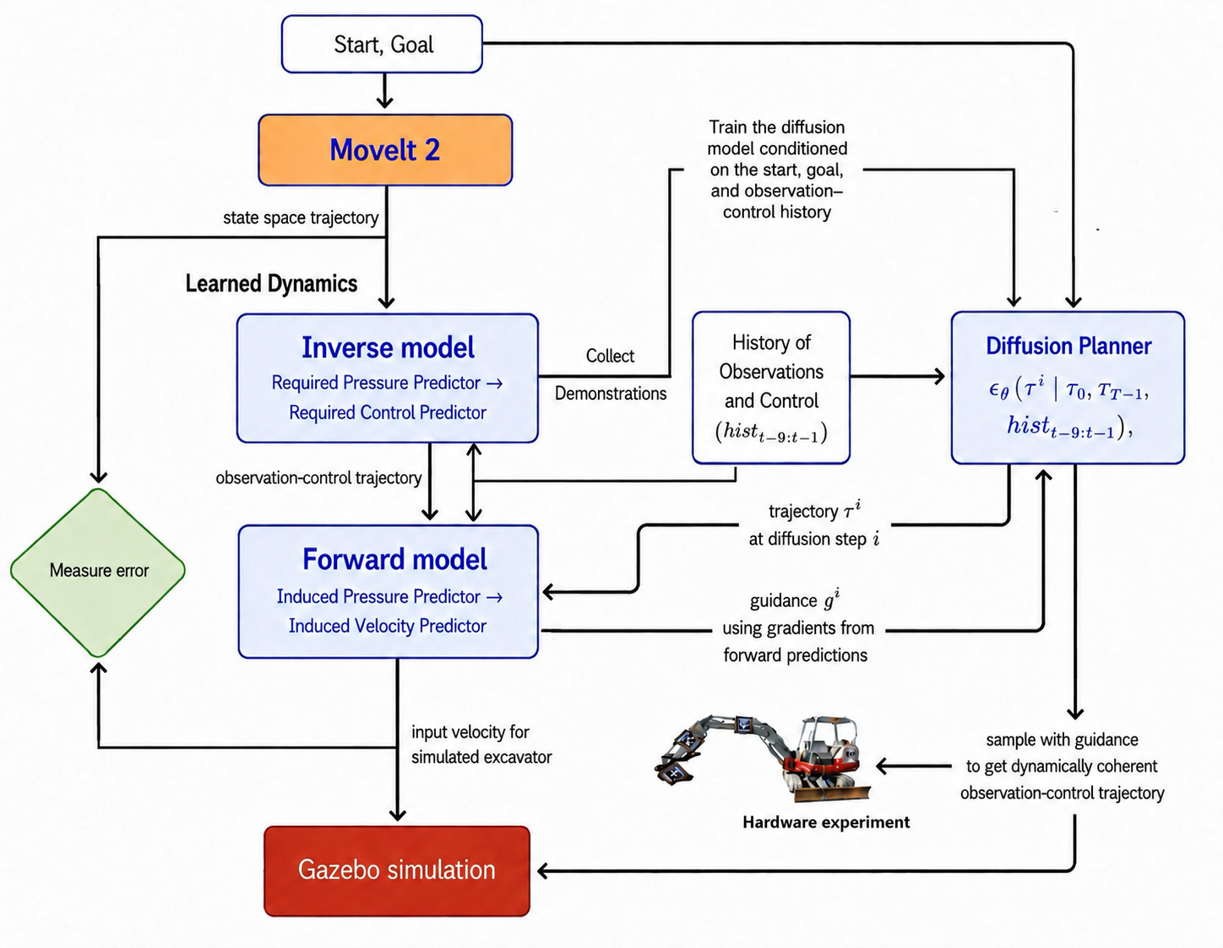
Dynamics-guided diffusion trajectory generation workflow for hydraulic excavators

Trajectory generation for hydraulic excavators is challenging because machine-specific nonlinear dynamics, hydraulic actuation delays, and valve dead zones make it difficult to convert a planned motion into feasible control commands. This work addresses that gap with a diffusion-based trajectory generation framework that uses learned forward and inverse dynamics models to produce dynamically coherent observation-control trajectories containing joint positions, joint velocities, hydraulic pressures, and control inputs.

Methodology

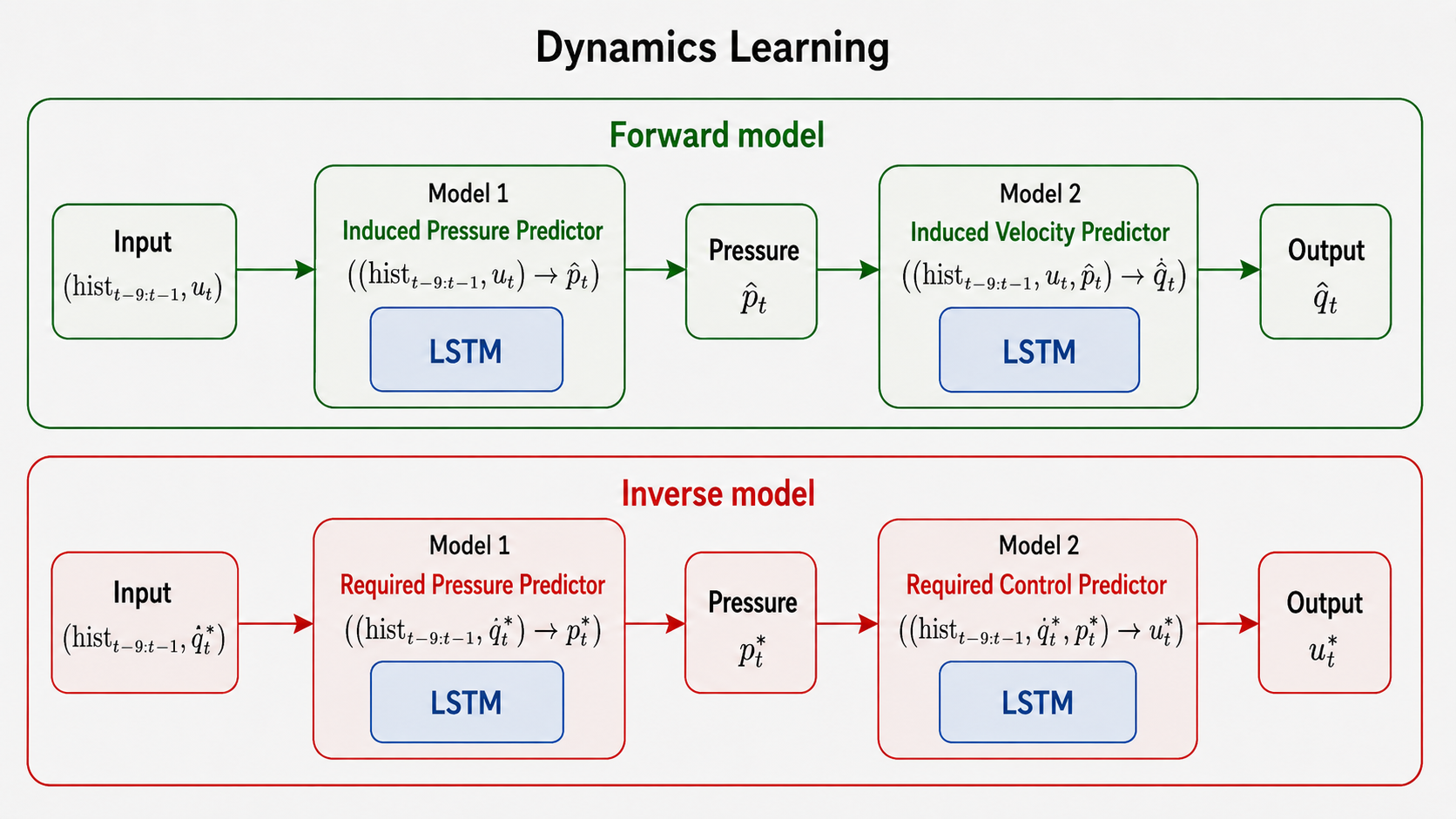
Learned Forward and Inverse Dynamics

  • Four LSTM dynamics models operate over a rolling history of joint angles, joint velocities, control inputs, and hydraulic pressures for the boom, arm, and bucket.
  • The forward models predict induced pressure and induced velocity from recent history and control input.
  • The inverse models predict required pressure and required control for a recent history and desired joint velocity..
Forward and inverse LSTM dynamics learning architecture
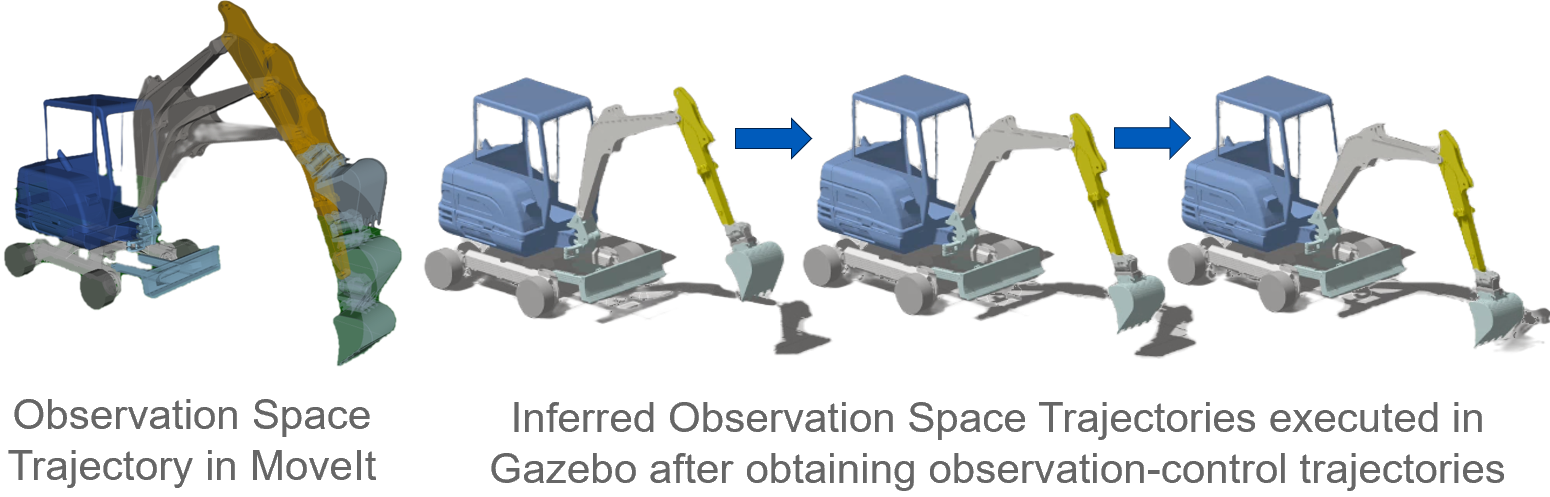
Observation-space trajectory in MoveIt and inferred trajectories executed in Gazebo

Simulation-based Demonstration Generation

  • MoveIt generates state-space trajectories from start and goal states.
  • The inverse dynamics model converts the state-space plan into state observation-control trajectories.
  • The forward model maps those controls into joint velocities for Gazebo execution, enabling scalable demonstration collection.

Dynamics-guided Diffusion Sampling

  • The diffusion planner is conditioned on start state, goal state, and a history of state observations and controls.
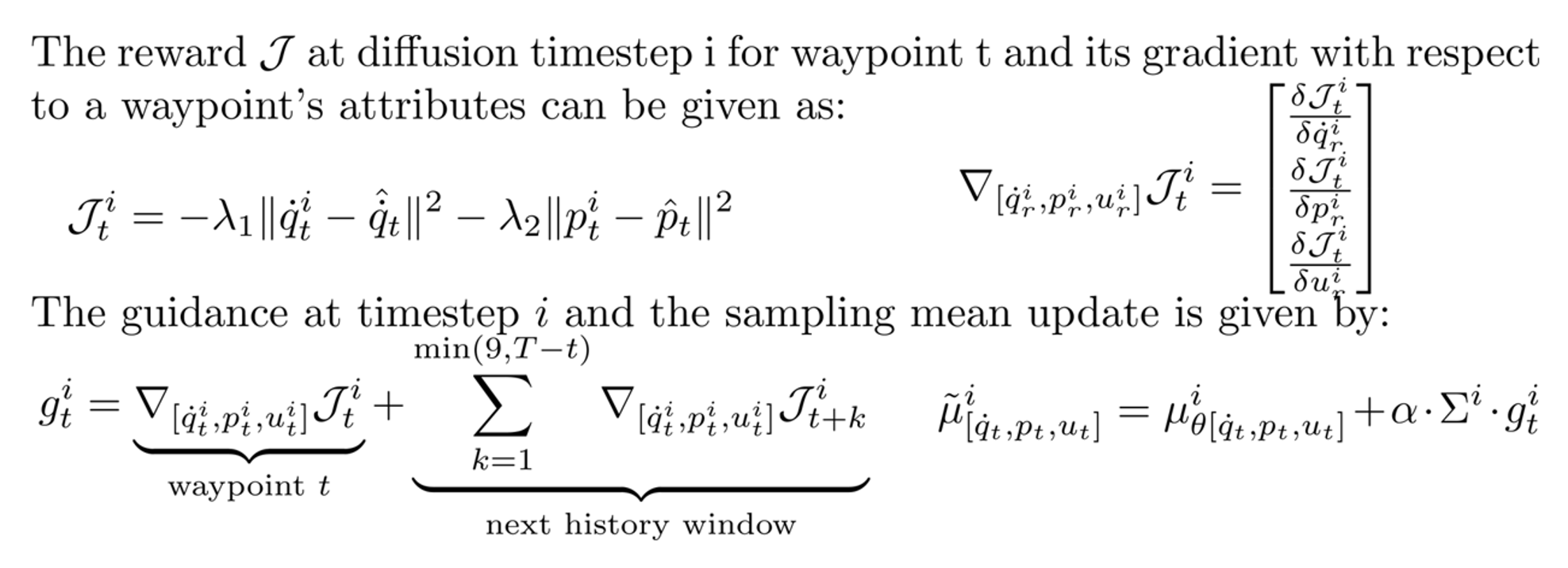
  • The gradient from the learned forward dynamics models is used as the guidance during sampling to generate dynamically feasible trajectories.
  • The sampler outputs observation-control trajectories that can be used in simulation and hardware experiments.
Reward and gradient guidance equations for dynamics-guided diffusion sampling

BibTeX

@inproceedings{turkar2025,
        title={Excavation Autonomy with Resilient Traversability and Handling},
        author={Yash Turkar and Christo Aluckal and Sugheerth Sreedharan and Yashom Dighe and Youngjin Kim and Jake Gemerek and Karthik Dantu}
        year={2025},
        booktitle={Workshop on Field Robotics (WFR), International Conference on Robotics and Automation (ICRA) 2025},
        url={https://droneslab.github.io/EARTH/}
      }
      
@INPROCEEDINGS{10979147,
        author={Aluckal, Christo and Kumar Lal, Roopesh Vinodh and Courtney, Sean and Turkar, Yash and Dighe, Yashom and Kim, Youngjin and Gemerek, Jake and Dantu, Karthik},
        booktitle={2025 IEEE International Conference on Simulation, Modeling, and Programming for Autonomous Robots (SIMPAR)}, 
        title={TERA: A Simulation Environment for Terrain Excavation Robot Autonomy}, 
        year={2025},
        volume={},
        number={},
        pages={1-6},
        keywords={Deformation;Scalability;Programming;Excavation;Real-time systems;Extensibility;Complexity theory;Time-varying systems;Autonomous robots;Excavation;Simulation;Autonomy},
        doi={10.1109/SIMPAR62925.2025.10979147}}