Legged robots operating in unstructured environments must reason about more than terrain geometry. Their behavior depends on terrain, commanded motion, robot dynamics, payload, and the locomotion controller.
Our research develops robot-centric representations that connect perception, physical interaction, locomotion adaptation, uncertainty estimation, and risk-aware navigation.
Rather than treating terrain as inherently safe or unsafe, we study how the robot and its controller respond while interacting with the environment.
CART · Context-Aware Terrain Adaptation for Stable Locomotion
42th International Symposium of Robotics Research (ISRR) 2026
Visual observations are interpreted together with recent physical interaction.
Terrain appearance does not always correspond to physical properties. Visually similar surfaces can produce different robot responses, while visually different surfaces can behave similarly.
CART combines visual observations with recent proprioceptive history. A temporal sequence-selection mechanism identifies relevant context and adapts velocity and body-height commands.
Task-Conditioned Uncertainty Costmaps for Legged Locomotion
29th conference on walking and climbing robots (CLAWAR) 2026
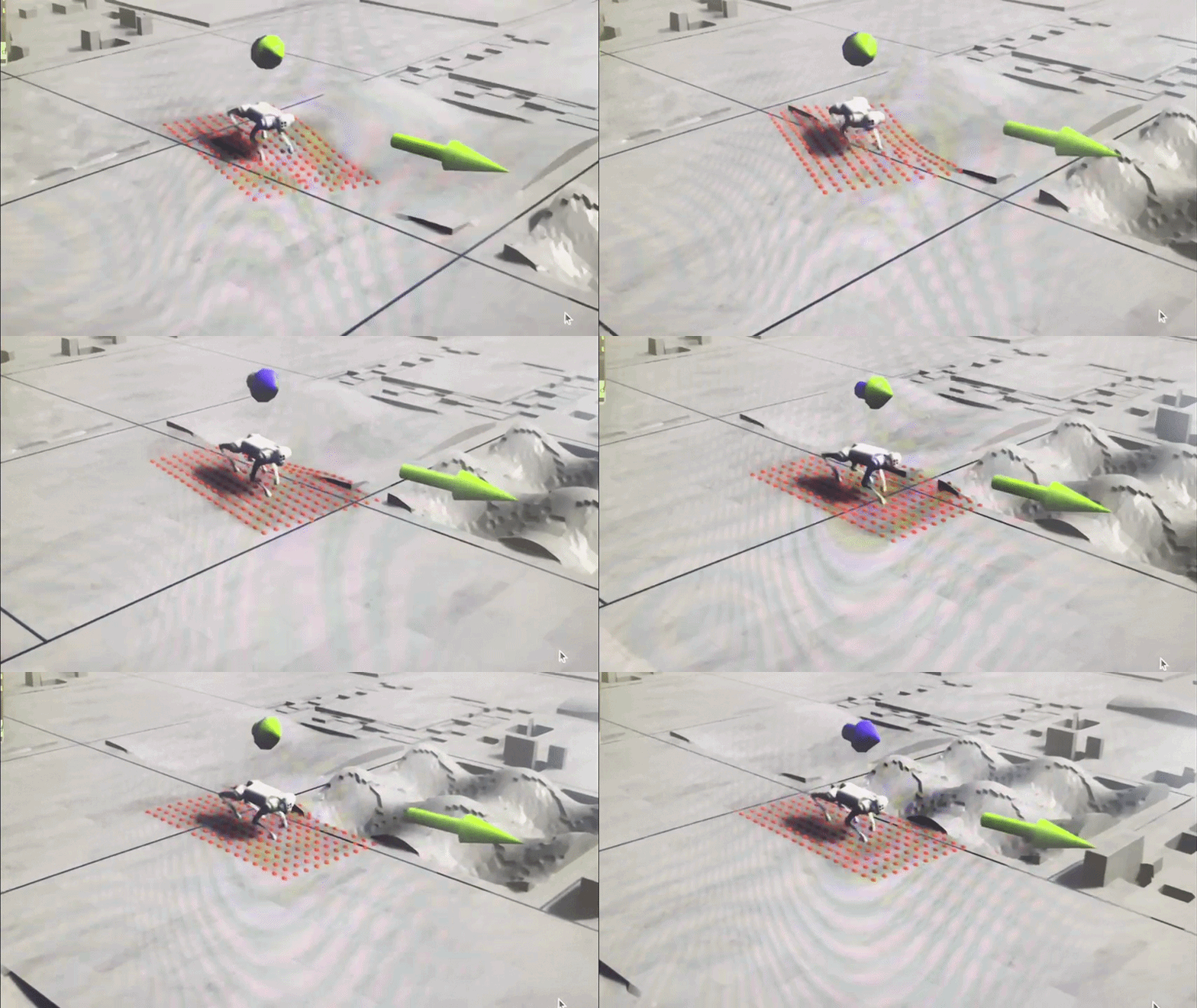
Terrain and commanded motion jointly determine predicted locomotion uncertainty.
Terrain uncertainty depends on the action the robot intends to execute. A terrain patch may be manageable under a slow command but unsafe under a fast or turning command.
This work predicts future footholds and their epistemic uncertainty using terrain observations, robot state, and commanded motion. The uncertainty is projected into spatial costmaps for MPPI and Nav2.
TERRA-Nav · Terrain-Encoded Locomotion with Risk-Aware Navigation
Work in Progress
A shared terrain-response representation connects locomotion learning and risk-aware navigation.
Terrain categories alone do not explain how a locomotion controller will respond. The relevant quantity is the controller-dependent behavior produced during terrain transitions.
TERRA-Nav learns a terrain-response representation from exteroception and proprioceptive history. It guides curriculum allocation during training and risk-aware command selection during deployment.
INSPECTOR · Autonomous Culvert Inspection
ICRA 2025 Workshop on Field Robotics
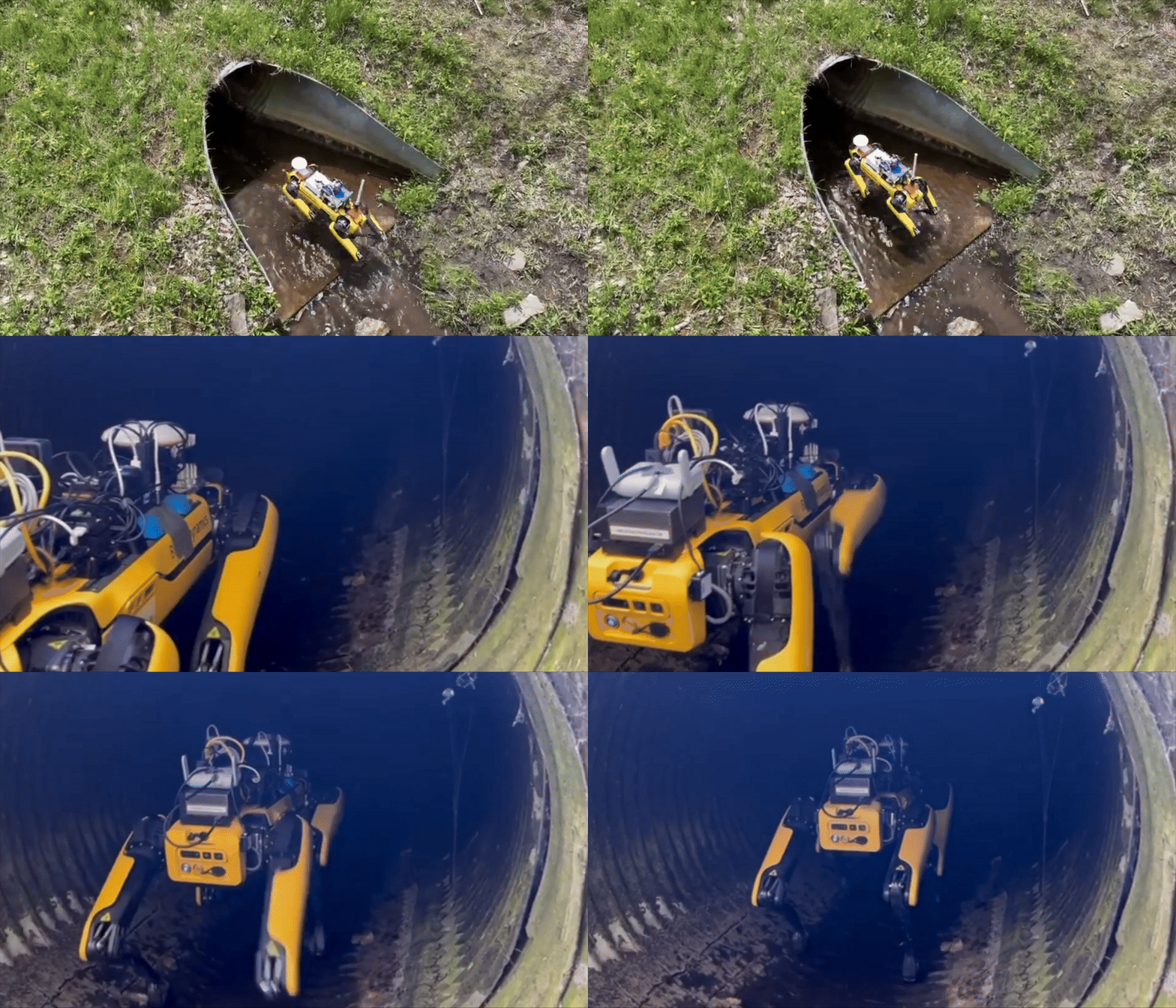
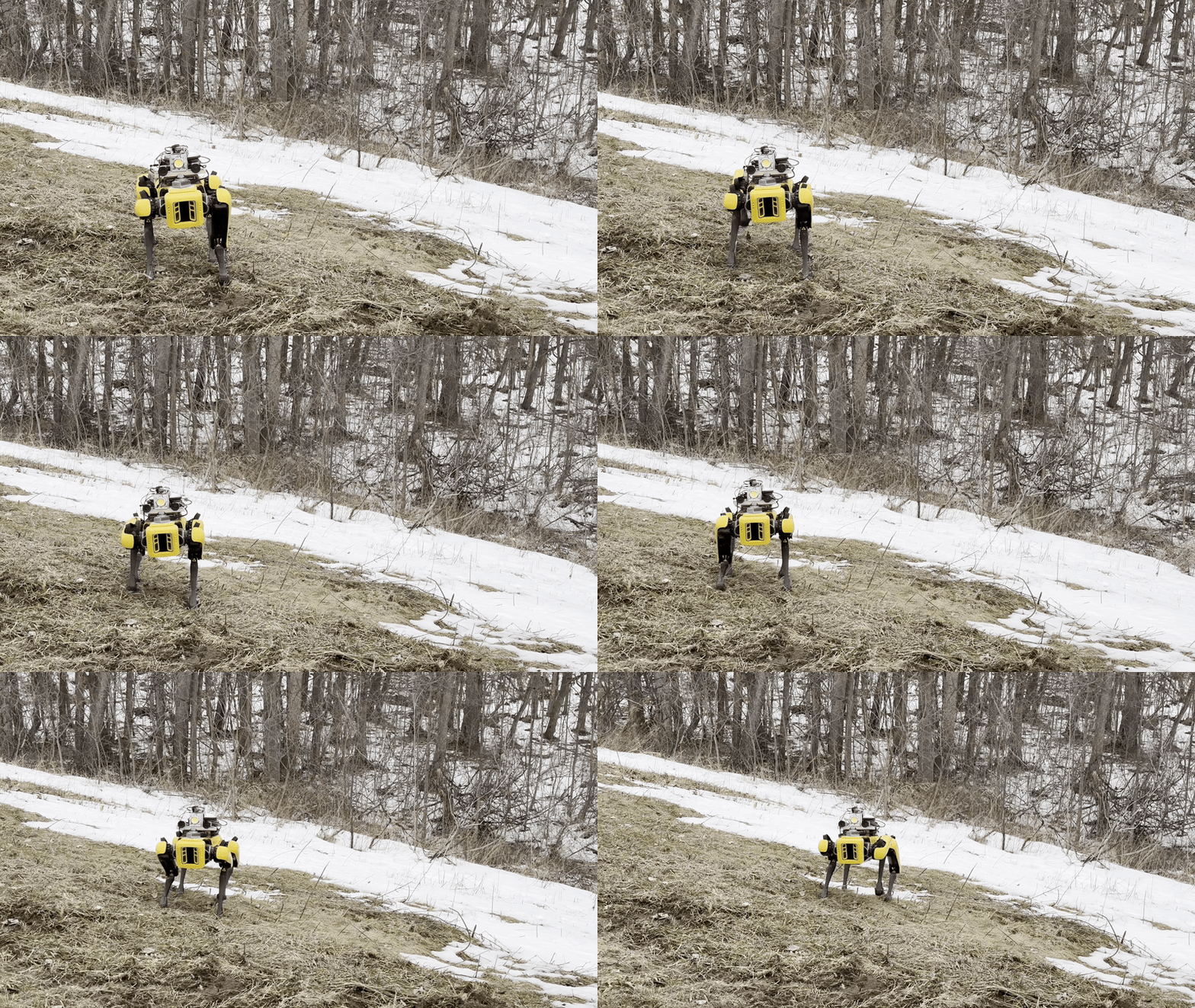
Autonomous traversal and inspection in challenging canal environments.
Real-world deployment introduces challenges that are difficult to reproduce in simulation, including steep slopes, poor illumination, vegetation, narrow spaces, water, and motion blur.
INSPECTOR demonstrates autonomous canal-culvert inspection using Boston Dynamics Spot, integrating bank traversal, navigation, active illumination, and visual inspection.
PANOS · Payload-Aware Navigation in Off-Road Scenarios
Accepted at NERC 2024
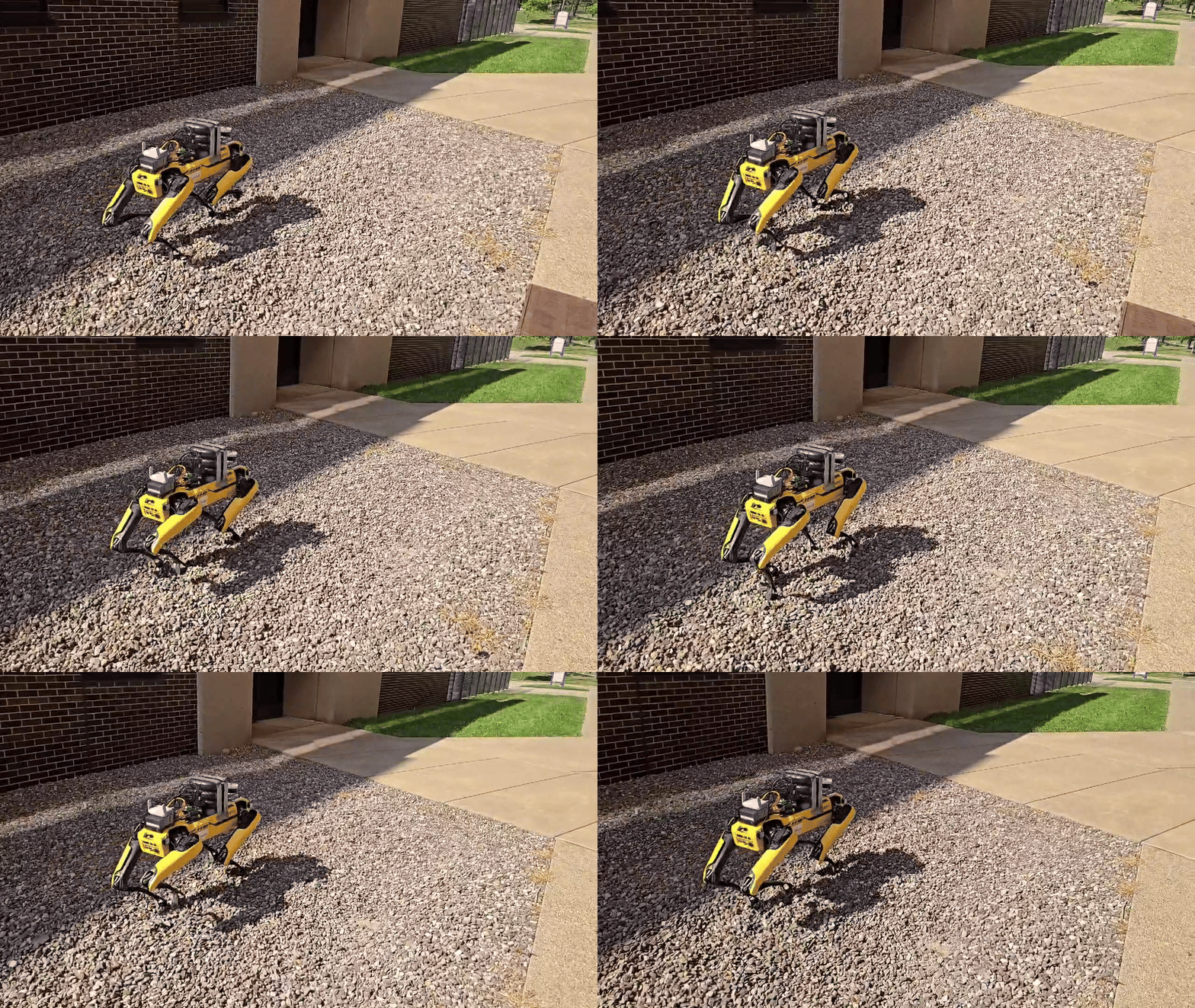
Terrain observations and proprioceptive response are combined for payload-aware locomotion.
Changes in payload alter the dynamics of a legged robot and can increase vibration, tracking error, and instability even when the terrain remains unchanged.
PANOS combines terrain observations with proprioceptive feedback to select stable locomotion commands across terrain and payload conditions without requiring explicit terrain-property labels.
TRACER · Hierarchical Decomposition of Terrain Adaptation for Quadrupedal Locomotion
IROS 2026 Workshop
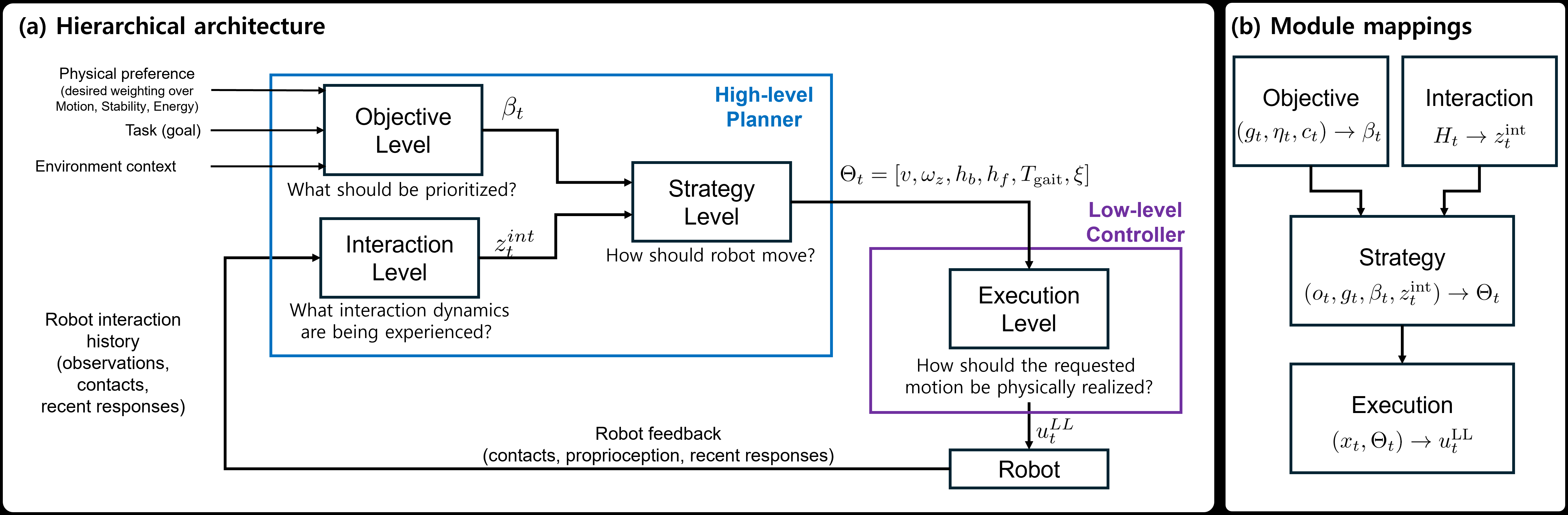
Terrain adaptation is decomposed into Objective, Interaction, Strategy, and Execution roles.
TRACER studies which component of a quadruped locomotion system should adapt when terrain-induced failures arise.
The framework explicitly separates task preference, robot–terrain interaction, high-level locomotion strategy, and low-level execution.
The long-term goal is to develop legged robots that understand both their environment and the limits of their own perception, controller, and physical capabilities.
These systems should estimate interaction context, quantify uncertainty, predict future behavior, and adapt planning and whole-body motion while maintaining safety.
This research is led by Kartikeya Singh under the supervision of Prof. Karthik Dantu at the DRONES Lab , University at Buffalo.